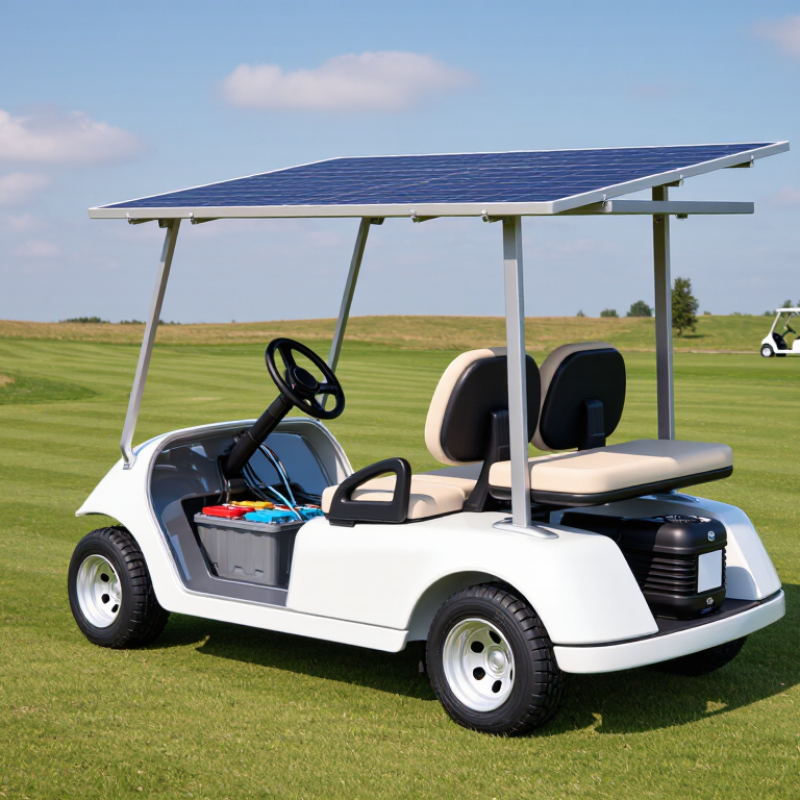
A solar golf cart looks simple: a dark panel above the seats, a battery pack below, and a quiet electric motor. But how does a solar golf cart work when sunlight changes by the hour? The panel converts sunlight into electricity. A charge controller regulates that energy as it reaches the battery, while the battery supplies power to the motor and accessories. In many designs, solar charging supplements conventional charging rather than replacing it.
The wider solar market gives useful context, but it does not prove that every cart performs equally. The Solar Energy Industries Association and Wood Mackenzie reported 32.4 gigawatts of new U.S. solar capacity in 2023 in their U.S. Solar Market Insight report. That is grid-scale context, not a golf-cart performance figure. For a cart, panel area, battery capacity, shade, route length, and parking time matter more. A cart parked beneath a leafy tree may gain little charge. Small detail. Big difference.
This guide explains the main components, charging process, and practical limits behind the 2026 best solar golf cart options. It also considers what buyers should check before comparing models, including battery chemistry, panel output, and backup charging. NREL’s PVWatts tool illustrates why solar production estimates depend on location, orientation, and shading. Still, estimates are not guarantees. Real-world use can be messier than a product chart suggests.
A 36–48 V golf cart usually draws power from a battery pack, through a controller, to an electric motor. The pack’s voltage must match the controller and motor ratings; installing a higher-voltage pack is not a harmless upgrade. In many 36 V carts, six 6 V lead-acid batteries are wired in series. A 48 V system may use eight 6 V batteries, four 12 V batteries, or a compatible lithium pack. Configurations vary.
Solar panels typically support charging rather than directly powering the motor. A roof-mounted panel sends energy through a charge controller selected for the battery’s voltage and chemistry. The controller regulates charging and helps prevent overcharging. On a sunny day, a small panel may add useful charge while the cart is parked, but shade, panel angle, and short daylight hours can reduce output. A dusty roof matters, too.
Check the battery label and cart documentation before choosing solar equipment. Lead-acid and lithium batteries require different charging profiles, even when their nominal voltages match. Wiring and protective devices should be sized for the system, and an experienced technician can verify compatibility. A common mistaken assumption is that a “48 V” label guarantees every 48 V charger will work. It doesn’t. Even a well-matched panel may extend range only modestly, so treat solar as supplemental energy, not a replacement for a properly charged pack.
2026 Best Solar Golf Cart: How Does It Work?
Core Components: PV Roof, Charge Controller, Battery, and Traction Motor
A solar golf cart starts with its photovoltaic (PV) roof. Sunlight makes direct-current electricity in the roof panels, but output changes with shade, cloud cover, panel angle, and dirt. A small leaf or branch can matter. The charge controller manages the electricity flowing toward the battery and helps prevent unsuitable charging conditions. With maximum power point tracking, it can adjust the electrical operating point as sunlight changes. It cannot create extra energy, though.
The battery stores the captured energy and supplies power when the cart moves. The traction motor turns that electrical power into wheel motion, usually through a motor controller that regulates speed and torque. The system works as a chain: roof, controller, battery, then motor. NREL’s PVWatts documentation applies a default 14% system-loss assumption when modeling grid-connected PV systems. That figure is not a golf-cart performance guarantee; small roof arrays can face additional shading and wiring losses. Real range varies.
In practice, the roof may extend driving time or reduce plug-in charging, rather than fully recharge a depleted battery. Check the controller’s settings against the battery’s chemistry and voltage. A mismatched setup can waste energy or stress components. Dust builds up quickly. Clean panels gently, and compare battery charge before and after a typical route. The result may be less impressive than expected. That is useful information, too.
Illustrative one-hour sunny-driving energy balance (kWh)
The PV roof converts sunlight into electricity. A charge controller regulates that power before it reaches the battery, which supplies the traction motor. In this example, the motor uses 1.20 kWh in one hour; a 350 W-rated roof averages 250 W during that hour, and a 95% controller efficiency delivers about 0.24 kWh to the battery. The battery therefore supplies the remaining 0.96 kWh. Actual results vary with sunlight, driving conditions, and system specifications.
A solar golf cart collects sunlight through photovoltaic panels mounted on its roof or another sun-facing surface. The panels convert light into direct-current electricity, even when the sky is slightly cloudy, though output usually drops. Small details matter: roof angle, dust, tree shade, and panel temperature can all change how much energy reaches the battery. A clean panel helps. It is not magic.
Wiring carries that electricity to a charge controller, which regulates voltage and current before they reach the battery. This step helps prevent overcharging and keeps charging within limits suited to the battery type. Some carts use a controller designed for lithium batteries; others need settings matched to lead-acid batteries. The wrong configuration can reduce performance or shorten battery life. The cart’s battery management system may provide additional protection, but it does not replace a compatible controller. During bright midday sun, charging may be stronger; under a shaded parking canopy, it may be modest. Solar power often extends driving range or offsets some plug-in charging rather than replacing it entirely. Checking charge readings over several ordinary days gives a more realistic picture than relying on a single sunny afternoon.
With about four equivalent full-sun hours, a 100–200 W roof panel can collect roughly 0.4–0.8 kWh before system losses. That is an estimate, not a promise. Cloud cover, shade from trees, panel angle, dust, and seasonal daylight all affect the result. Small differences matter. A golf cart roof is narrow, and it may not face the sun well throughout the day. Treat the figure as a planning range, not a guaranteed daily yield.
Solar energy usually flows through a compatible charge controller into the cart’s battery; it does not typically drive the motor directly. After conversion and charging losses, less energy reaches the battery than the panel produced. The contribution may offset some driving or accessory use, but many carts will still need regular charging. Battery size, passenger load, route, and tire pressure also change energy use. A shaded short trip can consume more than the roof gathers. I would track panel output and battery use for a week. The results may disappoint, but measured data beats assuming every day is sunny.
A solar golf cart uses rooftop panels to add energy to its battery while parked or moving. In most designs, solar power extends driving time rather than replacing plug-in charging. For a 2026 model, compare usable battery energy, not just amp-hours. Amp-hours mean little without voltage. Numbers can mislead.
Range depends on battery capacity, motor efficiency, passenger weight, hills, tire pressure, and stop-and-go driving. A quoted range may assume a light load on flat paths. Ask how it was measured, then consider your own route: a two-mile course with steep ramps can use more energy than a longer, level loop. Leave a practical reserve. The estimate will still be imperfect.
Charging rate needs two figures: the plug-in charger’s output and the solar array’s wattage. A higher-wattage panel can help during sunny hours, but shade, clouds, and panel angle reduce daily input. Check how many watt-hours the panel typically adds, and whether the charge controller matches the battery system. Compare this with your usual overnight charging time. A small roof panel may add only modest range, which is easy to overlook when reading sales specifications.
Roof panels convert sunlight into direct-current electricity. A charge controller sends suitable power to the battery. The motor uses stored energy to move the wheels.
Usually, no. Solar panels generally charge the battery rather than drive the motor directly. The battery supplies power while the cart moves.
With four equivalent full-sun hours, it may collect about 0.4–0.8 kWh before losses. Actual output can be lower. Shade matters.
Often not. A small roof panel usually adds charge or reduces plug-in charging. Treat it as supplemental energy.
No. Check the battery chemistry, controller settings, and system ratings. A 48 V label alone does not confirm compatibility.
Cloud cover, panel angle, tree shade, dust, and daylight hours all matter. Even a small leaf can block part of a panel.
No. They need different charging profiles, even at matching nominal voltages. Check the battery label and cart documentation before choosing equipment.
Clean the panels gently, then compare battery charge before and after a typical route. Track results for a week. The gain may be modest, and that is worth noticing.
A solar golf cart in 2026 typically uses a 36–48 V drivetrain, with a battery supplying power to the traction motor. Its main solar components are a photovoltaic panel mounted on the roof, a charge controller, the battery, and the motor. To understand how does a solar golf cart work, follow the energy: sunlight reaches the roof panel, which produces electricity; the controller regulates that output before it charges the battery. The battery then delivers power to move the cart, while solar charging can help extend use between plug-in charges.
Daily output depends on sunlight, panel size, shade, and operating conditions. A 100–200 W roof panel may generate about 0.4–0.8 kWh per day, making it a useful supplement rather than a guaranteed replacement for conventional charging. When comparing models, consider battery capacity alongside expected range and charging rate. These factors help determine how well a cart fits daily routes and how much benefit its solar system may provide.

Golvaris Car