A golf cart battery rarely fails without warning. Slower acceleration, shorter driving range, and visible corrosion often appear first. Understanding these signs is central to learning how to extend the lifespan of a golf cart battery.
According to the U.S. Department of Energy’s Vehicle Technologies Office, temperature, charging behavior, and maintenance strongly influence battery performance. The Battery Council International also identifies correct charging, safe handling, and routine inspection as important practices for lead-acid battery reliability. These findings apply directly to golf carts used on courses, resorts, farms, and private roads. A battery left deeply discharged may lose capacity faster. A charger that stops too early can create another problem.
Small details matter. Check water levels with protective gloves. Clean white corrosion from terminals. Keep the battery compartment dry and ventilated. Avoid storing the cart for weeks with a nearly empty battery. Simple actions help.
Still, no maintenance plan is perfect. Battery age, driving weight, terrain, climate, and charger quality can change the outcome. A cart climbing a steep hill in summer heat works harder than one moving across flat ground. Lithium-ion and lead-acid batteries also require different care, so copying one routine blindly may be a mistake. This guide combines manufacturer recommendations, field experience, and published battery guidance to explain practical steps that support longer service life, safer operation, and more predictable performance. Check the manual, not assumptions.
Understand the Factors That Affect Golf Cart Battery Life
A golf cart battery rarely fails from age alone. Its lifespan reflects charging habits, temperature, maintenance, and daily workload. Lead-acid batteries lose capacity faster when repeatedly driven until the cart moves slowly. Deep discharges strain the plates and may cause permanent damage. Recharge after normal use with a charger designed for the battery type. Do not stop the cycle because the gauge looks full.
Small habits matter.
Heat is another quiet factor. A cart parked in direct sun may expose batteries to damaging temperatures. The risk increases inside a closed shed. Store the cart in a cool, dry, ventilated area. For flooded lead-acid batteries, check electrolyte levels monthly. Add distilled water only after charging and according to the manual. Wear suitable eye protection and gloves. Keep terminals clean and tight. Corrosion increases resistance, forcing the motor to draw more current.
Heavy loads, steep hills, and underinflated tires also shorten operating time. The cart works harder.
Lithium batteries require different care, so never apply lead-acid maintenance steps to them. Follow the specified charger, storage level, and inspection schedule.
A battery management system can report warnings, but it cannot correct excessive heat or poor storage. I once focused only on charging and ignored tire pressure; range still fell. That mistake changed my maintenance checklist. Record charging behavior, run time, water use, and unusual heat. These details help a qualified technician identify problems with the battery, charger, or cables.
Choose the Right Charging Routine for Your Battery Type
How to Extend the Lifespan of a Golf Cart Battery?
Choose the charging routine that matches your battery chemistry. For flooded lead-acid batteries, recharge after each significant drive. A deep discharge left overnight can accelerate sulfation. Use the correct automatic charger, and allow a complete cycle before unplugging it. Check electrolyte levels after charging, not before. Add distilled water only when needed. Keep the plates covered, but avoid overfilling. Heat is unforgiving. The U.S. Department of Energy identifies temperature control and proper charging as major factors in rechargeable battery durability.
Lithium-ion batteries need a different habit. Follow the charger and battery-management system’s instructions, rather than copying a lead-acid routine. Avoid storing lithium batteries at full charge for long periods. Around 40–60% charge is often more suitable for extended storage. Do not charge a frozen or overheated battery. Let it return to a moderate temperature first. Do not guess.
A 2023 review in the Journal of Energy Storage links high temperature and high charge levels with faster lithium-ion aging. For lead-acid systems, Battery Council International’s 2023 National Recycling Rate Study reports a 99% U.S. recycling rate, showing the industry’s strong recovery infrastructure. Recycling does not repair poor charging habits, though. I still see owners unplugging early because the cart seems ready. That shortcut feels harmless, but repeated partial charging can reduce usable capacity. The perfect routine is not always practical. A simple charging log can reveal whether the problem is the battery, the charger, or the driver.
How to Extend the Lifespan of a Golf Cart Battery? - Choose the Right Charging Routine for Your Battery Type
| Battery Type |
Recommended Charging Routine |
Typical Full-Charge Time* |
Best Practice for Longer Life |
Avoid |
| Flooded Lead-Acid |
Recharge after each day of use with a charger designed for the cart’s battery-pack voltage. Allow the automatic charging cycle to finish. |
Approximately 8–10 hours |
Check electrolyte levels regularly and add distilled water only after charging, when the plates are covered and the battery has cooled. |
Deep discharges, overfilling, topping up with tap water, and charging in an unventilated area. |
| AGM Lead-Acid |
Recharge after use and use a charger with an AGM-compatible charging profile. Keep the battery connected until the automatic cycle is complete. |
Approximately 6–8 hours |
Keep terminals clean and dry, and store the battery fully charged. AGM batteries normally do not require routine water replacement. |
Using a flooded-battery equalization mode, overcharging, or opening the sealed casing. |
| Gel Lead-Acid |
Recharge after use with a gel-specific or gel-compatible charger. Use the manufacturer’s lower-voltage charging settings where required. |
Approximately 8–12 hours |
Maintain moderate charging temperatures and allow the charger to regulate the final charging stage automatically. |
High-voltage equalization, excessive charging current, and repeated operation until the cart stops. |
| Lithium-Ion |
Recharge when convenient after use with the battery’s approved charger and battery-management system. Frequent partial charging is generally acceptable. |
Approximately 4–8 hours |
Keep the battery within its specified temperature range and follow the recommended storage charge level during long periods of inactivity. |
Using a lead-acid charger, charging a damaged battery, or storing it fully depleted for an extended period. |
General charging guidelines: Match the charger to the battery chemistry and the complete battery-pack voltage. Charge in a clean, dry, well-ventilated location, inspect cables and connectors regularly, and follow the battery and charger manufacturer’s instructions. Charging times vary with battery capacity, depth of discharge, charger output, temperature, and battery condition.
*Charging times are typical planning ranges, not guaranteed durations. A compatible automatic charger should determine when the charging cycle is complete.
Maintain Proper Water Levels and Battery Cleanliness
How to Extend the Lifespan of a Golf Cart Battery?
Water level and cleanliness often decide whether a lead-acid golf cart battery ages slowly or fails early. Check the electrolyte after charging, when the plates are fully covered and the battery has cooled. Add only distilled water, and never fill above the marked level. Overfilling can push acidic liquid through the vents during charging. That creates corrosion around terminals and weakens nearby cables. A 2023 technical guide from the U.S. Department of Energy recommends controlled charging and regular inspection because heat and overcharging accelerate battery degradation. Small details matter.
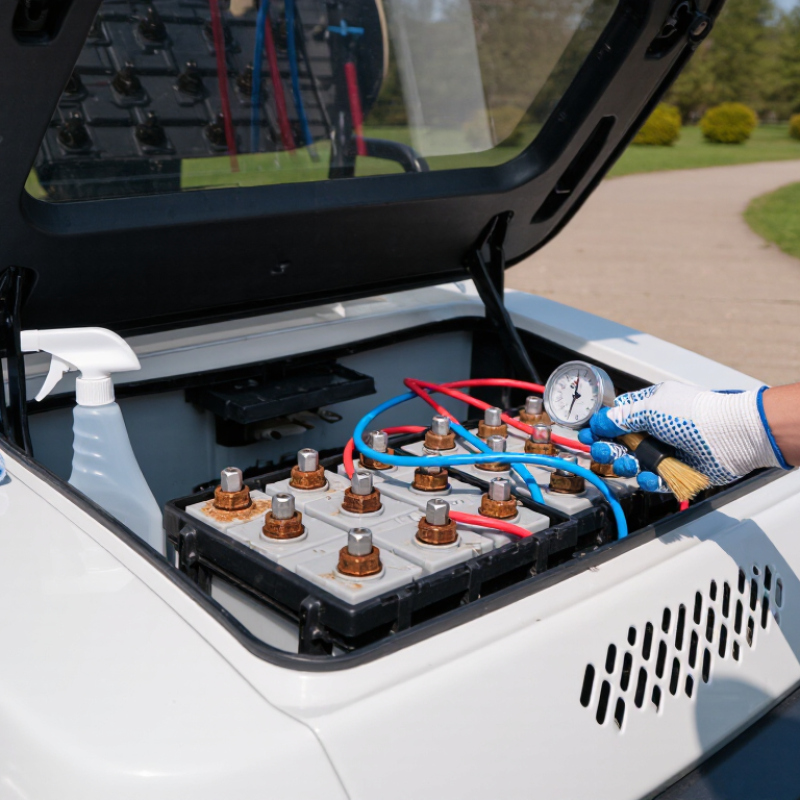
Keep the battery top dry. Dust mixed with moisture can form a conductive path between terminals, causing slow electrical leakage. Wipe the case with a damp cloth, then dry it completely. Inspect for white or green buildup every few weeks. A soft brush and an approved neutralizing solution can remove light corrosion; wear eye protection and gloves. Battery Council International reports a lead-battery recycling rate above 99% in the United States, but replacement should not be the first answer. Measure voltage and inspect charging behavior before discarding a battery. I once assumed a weak cart needed new batteries, but a low water level and loose connection caused the trouble. That mistake was expensive. A monthly maintenance record helps reveal patterns, especially after hot rides or long storage.
Prevent Heat, Vibration, and Deep Discharge Damage
How to Extend the Lifespan of a Golf Cart Battery?
Prevent Heat, Vibration, and Deep Discharge Damage
Heat quietly accelerates battery aging. During hot months, park the cart in shade whenever possible. Let the battery cool before charging it. A ventilated charging area matters. Never cover the battery compartment with blankets or loose materials. For flooded lead-acid batteries, check fluid levels only after cooling, and use the procedure in the owner’s manual. Sealed batteries should not be opened or filled.
Vibration can damage internal plates, terminals, and battery cases. Inspect the battery hold-downs every month. They should feel secure, but not crush the case. Look for cracks, swelling, loose cables, or white corrosion around terminals. Turn off the cart before inspection, and wear suitable eye and hand protection. I once blamed poor range on age, then found a loose mounting strap. Small faults can become expensive.
Deep discharge causes more stress than many owners expect. Recharge the battery after regular use, rather than waiting until the cart barely moves. If the cart sits unused, follow the charger and battery manufacturer’s storage instructions. Avoid repeatedly driving until the battery is completely flat. That habit feels efficient, but it is not. Charging problems may also come from a damaged cable or unsuitable charger, so test those parts before replacing the battery. Even careful maintenance has limits; battery chemistry still changes with time, temperature, and use.
How to Extend the Lifespan of a Golf Cart Battery?
Estimated battery capacity remaining after 12 months under common operating conditions
Keeping batteries cool, securing them against vibration, and avoiding repeated deep discharges can help preserve capacity. The values shown are practical benchmark estimates for lead-acid golf cart batteries; actual results vary with battery age, charging habits, climate, and maintenance.
Inspect, Store, and Test the Battery Regularly
How to Extend the Lifespan of a Golf Cart Battery?
A golf cart battery lasts longer when small problems are found early. I used to check only the water level, which was not enough. Now, I inspect the battery area every few weeks. Look for cracked cases, loose cables, corrosion, and damp marks around the terminals. A white, powdery buildup can increase resistance and reduce power. Turn off the cart before cleaning. Wear eye protection and gloves. Use a battery-safe brush, then dry the connections carefully. Never place a metal tool across two terminals.
For flooded lead-acid batteries, check the electrolyte level after charging. Add distilled water only when the plates are covered. Do not overfill the cells. Sealed batteries need different care, so follow their technical instructions. Storage also matters. Park the cart in a cool, dry, and ventilated space. Charge the battery before long storage, then check its condition regularly. Extreme heat can quietly shorten battery life. I once left a cart in a hot shed for two months. The battery still worked, but its range dropped noticeably.
Testing reveals wear that inspection cannot show. Use a suitable voltage meter after the battery rests. A load test can expose weak cells more accurately than voltage alone. Record the readings and dates. If one battery differs sharply from the others, investigate it early. I sometimes skipped this recordkeeping, and that made gradual changes easy to miss. A qualified technician should handle unusual heat, swelling, leaking, or repeated charging failures.
Conclusion
Extending the life of a golf cart battery begins with understanding the factors that influence its performance, including battery type, charging habits, operating conditions, usage frequency, and maintenance quality. To learn how to extend the lifespan of a golf cart battery, use a charging routine suited to the battery’s design, avoid frequent deep discharges, and recharge it at the appropriate time. Keeping terminals clean, connections secure, and water levels properly maintained is also essential for batteries that require water.
Protect the battery from excessive heat, strong vibration, moisture, and prolonged periods of inactivity. Regularly inspect the case, cables, and terminals for damage or corrosion, and test the battery periodically to identify declining performance early. When storing a golf cart, keep the battery in a suitable environment and follow the correct maintenance-charging process for its type. These simple, consistent practices can improve reliability, preserve usable capacity, and help reduce premature battery replacement.

 Golvaris Car